Leucojum
Family: Liliaceae Leucojum derives from the Greek for "white violet [the flower]" Part of the Amaryllid sub-family according to the classification used here. Amaryllids are: Leucojums are Amaryllids with: Galanthus (snowdrops) are distinguished by the inner three tepals forming a distinct bowl-shaped structure. However, some (non British Isles) plants previously classified as Leucojum have been found to be genetically more distinct than Galanthus and are now re-assigned to Acis. Notes about this intriguing genus - ongoing and subject to errors (by John Crellin). The genus Leucojum now has only two species: L. aestivum and L. vernum but L. aestivum has two sub-species (and there are several garden variants of each). All other species that were classified as Leucojum are now being moved to Acis. See this link (There are other differences but all Acis have no green/yellow markings at the end of the tepals.) Older names for the current Leucojum species include:
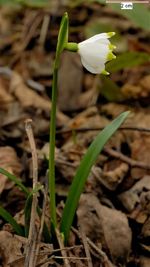
Leucojum vernumApart from being called the Spring Snowflake this is also known as St. Joseph's Bells in the UK.
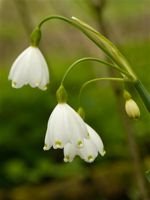
Leucojum aestivum
This information comes from Stace and the website www.amaryllidaceae.org. The flowering time estimates are mine based on sources mentioned below and observation here in Weston-super-Mare. If you are really "into" this see my measured characteristics below.) It certainly seems intriguing to me that the flower has clearly been named "Summer Snowflake" in more than one country for many centuries. In view of the manifest failure to flower in high summer here in the UK and bearing in mind the variation shown in the sub-species I do wonder whether the species is quite variable in this characteristic. But Patrick Roper has a cogent explanation: "On the topic of names, I suspect 'Loddon lily' is an old name that was current before Linnaeus called the plant 'Leucojum aestivum' in 1759. Subsequently Linnaeus's Latin was translated as 'summer snowflake' or its equivalent in English and other languages. He used the word 'aestivum' (summer) because that is when it flowered in central Sweden where he lived. According to Mariette Manktelow at the University of Uppsala in Sweden, who is a leading expert on Linnaeus, he probably named the summer snowflake 'aestivum' because, with them, it flowers in May and June and later than the spring snowflake which is out in April and May." (Other common names include: Loddon Lily; Devon Snowflake; St Agnew flower and St George's Violet.) Update after a visit to the L. aestivum subsp. aestivum on the River Loddon, near Reading, UK. There is a large variation in the flower size among the wild plants at this site (10 to 30 mm tepal length) and also the flower form varies more than I have seen in garden varieties. I could not see the green striations on flowers mentioned at www.amaryllidaceae.org but the flowers are often striated with darker lines. (See the pictures.) E A Bowles in his classic "My Garden in Spring", published in 1914, had this to say about Leucojum: The Spring Snowflake is so nearly a Snowdrop and flowers with the later ones that I shall praise it here. My favourite form is that known to science as Leucojum vernum, var. Vagneri, but which lies hidden in catalogues and nurseries as carpathicum. Both are larger, more robust forms than ordinary vernum, and strong bulbs give two flowers on each stem, but whereas carpathicum has yellow spots on the tips of the segments, Vagneri has inherited the family emeralds. It is an earlier flowering form than vernum, and a delightful plant to grow in bold clumps on the middle slopes of the flatter portions of the rock garden. Plant it deeply and leave it alone, and learn to recognise the shining narrow leaves of its babes, and to respect them until your colony is too large for your own pleasure, and you can give it away to please others. L. Hernandezii, also known as L. pulchellum, has won a place in my affections by its useful preference for wet feet. Like the larger and finer, but later L. aestivum, it thrives well on the very edge of water, and looks so much better there than anywhere else, that I advise such a planting. Hernandezii flowers over a long period, throwing up a succession of flower-stems, and it comes in Daffodil days, at a time when other white water-side flowers are asleep. Note what he says about his "Hernandezii " flowering longer and earlier. A correspondent to the Pacific Bulb Society email list living in Kansas City, Missouri reports that L. aestivum blooms prior to L. vernum there. Leucojum is from Greek - literally "white violet". This seems to be the accepted modern spelling but many would say the older one - Leucoium was more faithful to the Greek derivation. Distribution L. aestivum subsp. aestivum : Ireland, The United Kingdom, Netherlands, Belgium, Germany, France, Switzerland, Italy, Austria, Yugoslavia, Albania, Greece, Czech Republic, Slovakia, Hungary, Romania, Bulgaria, Ukraine (SW and the Crimea), Turkey, Iran, Georgia, Russia (the Caucasus). L. aestivum subsp. pulchellum : France (the Alps-Maritimes., Corsica), Spain (Balearic Islands), Italy (continent, Sardinia). Garden use Leucojum aestivum has been cultivated since the 16th Century at least. The selected form Gravetye Giant is popular in the UK and was named in 1924 by William Robinson of Gravetye Manor. (I believe it is a selected form of L. aestivum subsp. aestivum.) The distribution maps of the two sub-species in the UK are interesting - showing that those growing "wild" in many parts of the UK (eg where I live) are actually L. aestivum subsp. pulchellum - and hence the logic goes - must be garden escapes as that sub-species is not native to this country. The assumption must be that L. aestivum that was brought into the country commercially (or otherwise) a while ago tended to be subsp. pulchellum (from the Mediterranean ?) - whereas commercially supplied bulbs are often subsp. aestivum now. John Grimshaw comments: "Conceivably there is a L. aestivum that is not ssp. aestivum or ssp. pulchellum, but if so it hasn't been discovered! It would be nice to know more about the range of variation in the species, but L. aestivum is one of those plants that gardeners don't take much interest in - and most academic botanists simply do not notice the variation that interests gardeners. Also it grows in awkward wet places where most of the bulb enthusiasts would never think of going, so one never hears about people seeing it in the wild. There is a dearth of selections in gardens, 'Gravetye Giant' being the only formally named one to my knowledge. I have a strong suspicion that most of the bulbs sold by the trade are wild collected so there must be a flow of variation coming into gardens." My own recorded characteristics of Leucojum aestivum
|
|
||||||||||||||||||||||||||||||||||||||||||||||||||||||||||||||||